Loading blog post...
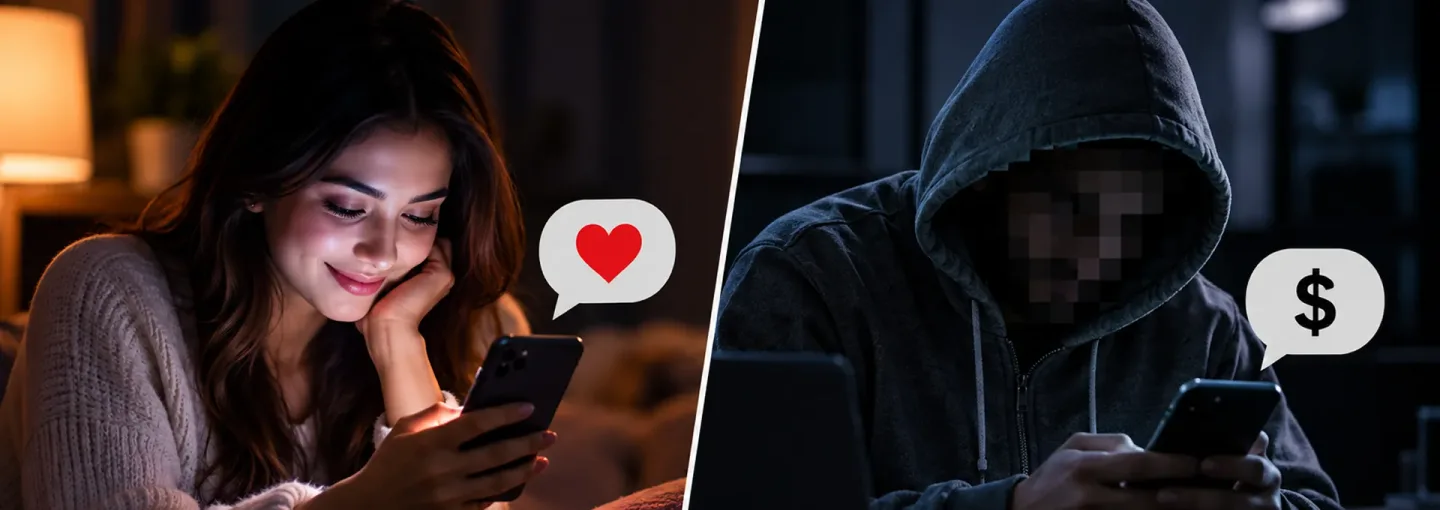
A friend of mine told me about a guy she had been chatting with for about three months. He said he was a widowed engineer on an oil rig somewhere off the coast of Norway. He sent her a good morning text every day without fail. He knew her dog’s name. Then one evening he told her he needed $4,000 for a customs fee so he could finally fly out and meet her.
She didn’t send it, but she told me afterward that she came close. What bothered her most was how ordinary it all felt. No red flags flapping around, no creepy messages. Just a nice man who seemed to care.
That is how a romance scammer works. They don't come across as criminals. They come across as the person you were hoping to meet. For many of them, it is a full-time job with scripts, targets, and daily quotas, often run by organized groups rather than one lonely guy at a laptop.
In the US, reported losses to romance scams reached $1.14 billion in 2023, according to the FTC, and that only counts the people who actually reported it.
We’ll go through common romance scammer tactics, the warning signs of a romantic scammer, the questions to ask when something feels off, and what to do if you have been romance scammed.
Verify their identity: Reverse image search their photos, check their social media profiles, and look for inconsistencies in their stories.
Watch for red flags: Be cautious if someone declares love too quickly, repeatedly avoids live video calls, or makes excuses for not meeting in person.
Never send money: Don't send money, gift cards, cryptocurrency, or financial details to someone you haven't met in person.
Ask questions and set boundaries: Ask about their daily routine, take your time building trust, and notice how they respond when you say no.
Talk to someone you trust: Share your concerns with a friend or family member who can offer an outside perspective.
Act quickly if you've been scammed: Stop contact, notify your bank or payment provider, secure your accounts, save evidence, and report the scam. In India, visit cybercrime.gov.in or call 1930.
Romance scammers rarely invent new tricks. They rely on a small set of tactics that work because each one targets emotion before logic. Once you recognize the playbook, the pattern becomes much easier to spot.
Tactic | What it looks like | How to respond |
|---|---|---|
Love bombing | Constant compliments, “soulmate” talk and declarations of love within days or weeks | Slow the pace on purpose and see how they react to a calm boundary |
Perfect backstory | A widowed engineer, deployed soldier or overseas doctor with a ready excuse for never meeting | Check the story independently and ask for a live video call |
Moving off the app | A request to switch to WhatsApp, Telegram or plain text within a few messages | Stay on the platform until you have verified who they are |
Sudden crisis | An accident, frozen account, customs fee or sick relative appears right after trust is built | Never send money, and talk to a friend before replying |
Investment pitch | A friendly contact mentions easy profits on a trading platform that only they seem to know | Walk away; real partners don’t steer you toward unfamiliar platforms |
Isolation | “Keep this between us” or “your family is just jealous” | Show the messages to someone you trust |
Sextortion | Pressure for intimate photos or videos, followed by threats to share them unless you pay | Stop contact, save the evidence and report it; never pay |
Each of the 15 ways below is designed to interrupt one or more of these tactics.
If you only have a minute, check this list. One sign on its own may mean nothing, but two or three together are a strong reason to stop and verify.
Warning sign | Why it matters |
|---|---|
Their photos lead to another name or a stock image | The pictures were most likely stolen to build a fake identity |
They declare love very quickly | Fast attachment lowers your guard before you can verify anything |
They avoid live video calls with repeated excuses | A real person can usually manage a short call; a scammer can’t risk showing a different face |
They can never meet in person | Being always abroad, deployed or offshore is a ready-made excuse |
They ask to leave the dating app early | Off the platform, they can’t be reported or banned |
Their story keeps escalating into emergencies | Each crisis prepares the ground for a request for money |
They ask for money, gift cards or crypto | Hard-to-trace payments are the scammer’s preferred method |
They push an investment or trading platform | This is the pattern behind “pig butchering” scams |
They guilt-trip you when you slow down | Real interest can wait; a scammer is working against the clock |
They ask you to keep the relationship secret | Isolation keeps friends and family from spotting the pattern |
Spotted a few of these? The next section shows you exactly how to check, step by step.
Most people picture the victim as someone old, lonely, or naive. That picture is wrong. Scammers go after anyone open to a connection, and that covers a huge number of people: the recently divorced, the widowed, people who just moved to a new city, and people who are simply busy and tired of swiping.
They also do their homework. They read your profile and your posts, then build a person around what you've told the world. If you mention you're a teacher, suddenly they have a sister who teaches. If you say you lost your husband, funny enough, they lost their wife too.
The people who get caught are very often the ones who were sure they'd never fall for it. Once you stop assuming you're immune, you start checking things, and checking is what protects you.
This takes about thirty seconds and catches a surprising number of fakes. Scammers steal pictures from real people, models, influencers, military members, whoever has a good-looking public gallery. Then they wrap a whole fake life around those photos.
Save a few of their pictures and upload them to Google Images or TinEye. If the same face turns up under another name, another job, or another country, you have your answer. If the photos lead to a stock photo site or a stranger's Instagram, you're done.
A clean result doesn't prove they're real, though. Some scammers use AI-generated faces now, and others use photos of people who simply aren't online much. Think of this as a filter that catches the lazy ones, not a guarantee.
People in the business call it love bombing, and it is one of the oldest romance scammer tactics around. It is creating emotional attachment before you have enough time to verify who the person really is. People in the business call it love bombing, and it is one of the oldest romance scammer tactics around. The aim is to get you attached before your common sense wakes up.
Pay attention if the person also looks a bit too perfect on paper. Handsome, successful, widowed with one adorable child, deeply religious, working in the military or on an offshore project or as a doctor with an international aid group. Those backstories get picked for a reason. They give the scammer a ready excuse for why they can't meet you or hop on a video call.
If someone is talking about forever before you've even compared notes on your ordinary weeks, slow down. A genuine person won't mind.

Try this. Tell them, kindly, that you're enjoying getting to know them but you like to take your time.
Someone actually interested will say something like "sure, no rush." A scammer is working against a clock. Every extra week gives you more chances to talk to a friend, run a search, or spot an inconsistency. So you'll often get pushback. They'll sulk, say you don't trust them, or tell you they're hurt that you'd doubt their feelings.
How a person responds to a boundary tells you more than a hundred sweet messages. Remember that one.
Nearly every scammer dodges live video. The excuses sound fine on their own. The camera's broken. The internet on the site is awful. They're not allowed phones in that area. They're shy. Next week, definitely.
Ask for a real-time video call within the first week or two. Not a recorded clip, and not a voice note. Something live where they have to react to you. Ask them to wave, hold up three fingers, or turn the camera toward the window. If they avoid it again and again, that's the answer.
Be aware that deepfake filters exist, and some scammers hire a real person to show their face on camera while someone else runs the chat. Watch for lips that don't quite match the audio, odd glitches around the face, or a call that mysteriously drops every time you ask for something specific. If it feels off, treat it as off.
If I could keep only one rule from this whole list, it would be this one. The reason doesn't matter. It could be a medical bill, a visa problem, a customs fee, a frozen bank account, a plane ticket to come and see you, or a business deal that's about to pay off. Some scammers start small, with a phone top-up or a gift card, because once you've paid once, saying no the second time gets harder.
If you've never met the person face to face, you don't send money. Not as a loan, not "just this once," not even a small amount. The FTC gives the same advice: never send money or gifts to someone you haven't met in person, even if they send you money first. Someone who really cares about you will understand why you won't, and they won't need your cash to prove their feelings.

Scammers love payment methods that are quick, hard to trace, and hard to undo. Gift cards, wire transfers, cryptocurrency, prepaid cards, and some payment apps all fit that description. Once the money has moved, getting it back is rare. Gift card codes get drained within minutes, and crypto can't be recalled.
There's a version of this that's worth knowing about. It's often called pig butchering. A friendly person you've been chatting with for weeks mentions, almost in passing, that they've been making good money on a trading platform. They offer to show you. You put in a small amount; the website shows nice profits, so you put in more. When you try to withdraw, suddenly there are fees, taxes, or a frozen account, and each one needs another payment.
Anyone who mixes romance with investment tips is almost certainly running a con. Real partners don't introduce you to a "platform" that only they know about. The FTC has pointed out that romance scammers take their time, build the relationship first, and only later steer the conversation toward helping you invest, and reported losses to romance scams rose by 22% in 2025.
Early on, you don’t owe anyone your full address, your workplace, your date of birth, or the state of your savings. Those details can be used for identity theft or to tailor a more convincing story to you.
Be extra careful with private photos or videos. Sextortion is a growing branch of romance scamming. You share something intimate, and then the other person threatens to send it to your family, your boss, and your contacts unless you pay. If nothing sensitive was ever shared, there's nothing to hold over you.
Also, never let a new online friend take remote control of your computer, never install an app because they asked you to, and never agree to receive money or packages and pass them along to someone else. That last one can turn you into a money mule, and you may end up with legal trouble you never expected.
Dating apps have safety tools built in, such as reporting, blocking, and moderation. Scammers know this. So within a few messages they'll ask to switch to WhatsApp, Telegram, Signal, or plain text. The explanations vary. It's easier, it's more private, they hardly use the app anyway.
What they really want is to get out of reach of the platform. Once you've moved, they can't be banned, and the record of how you met is gone.
Plenty of honest people prefer texting, so moving apps isn't a red flag by itself. Put it together with fast declarations of love and a refusal to do video, though, and it fits a pattern.

Scammers often work from templates, and the seams show if you read closely. Things to watch for:
One of these might be nothing. Two or three together should make you stop and look again.
Look for inconsistencies across their dating profile and social media accounts. If they refuse to share basic information about their relationship status or become defensive when you ask reasonable questions, take a step back and verify before becoming more emotionally invested.
Ask questions that are difficult for someone working from a rehearsed story to answer naturally. Ask where they usually get coffee near their house, what they did at work on a boring day, or bring up a basic fact they told you weeks ago and see if they remember it.
You can also ask for something spontaneous, like a silly selfie or a quick phone call. The point isn't to interrogate them. It's to see whether you're talking to a real person with an ordinary, consistent life or someone managing a character. A genuine person might forget a detail, but their answers should generally feel natural and consistent over time.
Scammers love isolation. They'll often tell you to keep the relationship quiet. "People won't understand." "Your family is just jealous." "Let's keep this between us." The less anyone else knows, the fewer people there are to ask awkward questions.
So do the opposite. Tell a friend or a sibling or a neighbor, anyone who knows you well. Show them the messages and the profile.
Then comes the part that's genuinely hard. If they're worried, resist the urge to defend the person. Many victims say later that everyone around them tried to warn them and they argued back. Scammers set this up in advance by telling you that others will try to break you two apart. If people who love you are uneasy, take it seriously. They aren't caught up in the feelings, so they can see things you can't.

A search can save you months. Type in their name along with words like "scam" or "fake." Check whether their email address or phone number shows up on scam-reporting sites. Copy a distinctive line from one of their love messages and search that too, because scammers reuse the same letters on lots of people.
Look at their social media. A real person usually has a messy trail: old photos, tagged friends, comments from cousins, posts spread over years. A scammer's profile tends to be new, thin, or crammed with a handful of glamorous shots and almost no real interaction.
If they say they work for a specific hospital, company, or military branch, check that yourself. Don't use any contact details they give you. Find the organization's official site on your own.
You know more than you think you do. If something about their story, behaviour, or timing feels off, don't ignore that feeling just because you can't explain it yet. After the fact, victims often say, “I knew something was wrong, I just talked myself out of it.” Treat discomfort as a reason to slow down, verify their story, and talk to someone you trust.
Ask specific, everyday questions about their life rather than relying only on romantic conversations. Ask about their routine, neighbourhood, workday, or something they mentioned earlier. Then bring up the same detail later and see whether the answer stays consistent. Romance scammers often manage broad stories well, but small details can expose gaps in a carefully rehearsed identity.

Scammers work from scripts and often manage many victims at once, so they struggle with specific, everyday detail. The goal of these questions to ask a romance scammer isn’t to interrogate anyone. It’s to see whether you’re talking to a real person with a consistent life. These trap questions work best when you spread them across several conversations instead of firing them off all at once.
How to read the answers: a real person may forget a detail or feel a little awkward. What you’re looking for is a pattern of vague replies, long delays, changing stories, deflection back to love and money, or anger when you ask. If the answers don’t add up, don’t confront them. Pull back, verify what you can and talk to someone you trust.
Sometimes it happens anyway. If you're searching for what to do if you have been romance scammed, remember that it isn't your fault, and it doesn't mean you're stupid. Speed matters, so work through these steps as quickly as possible.
Don't confront the scammer or send a final message. Do not send any more money, even if they promise to pay you back or threaten you. Block them everywhere.
Tell them you've been a victim of fraud. If you paid by card, bank transfer, or payment app, they may be able to flag or dispute the transaction. For gift cards, contact the card company with the card numbers and receipts.
hange the passwords for your email, banking, and social media accounts, especially if you shared login details or gave the scammer access to your device. Enable two-factor authentication and remove any remote-access software or suspicious apps.
Keep messages, usernames, phone numbers, photos, receipts, and transaction IDs. Take screenshots before the scammer's profile or messages disappear.
In the US, report it through the FTC and the FBI's Internet Crime Complaint Center. In India, use cybercrime.gov.in or call 1930. You should also report the scammer's profile to the dating app or social media platform.
Someone may later claim they can recover your money for an upfront fee. Be cautious, as these can be another scam. Genuine authorities do not require you to pay them to recover stolen funds.
Romance scams can cause shame, anger, grief, and genuine heartbreak because the relationship feels real. Talk to someone you trust, a counsellor, or a support group. Getting your money back matters, but so does taking care of yourself.
None of this means you should give up on online dating. Lots of people meet good partners that way, and you might too. It just means letting trust be earned over time instead of handed over on demand.
The scammer's playbook is pretty predictable once you've seen it. Rapid affection, a handy reason to avoid video, a crisis, then a request for money. When you can spot that sequence, it loses a lot of its pull. You start noticing the script before the emotions get involved.
So run the image search. Ask the everyday questions. Insist on a real video call. Tell a friend what's going on. And don't send money to anyone you haven't met in person.
If the person is who they claim to be, none of that will bother them. If it does, you've just outsmarted a romance scammer.
Our Concierge Team Is Available 24/7 To Assist You
A romance scam is an online fraud where someone creates a fake romantic identity to build trust and eventually exploit you. They may ask for money, personal information, or intimate content.
Common signs include moving the relationship too quickly, avoiding video calls, making excuses for not meeting, asking for money, and creating repeated emergencies. Inconsistencies in their stories can also be a warning sign.
Take time to verify their identity through a live video call, reverse image search, and online research. Also, check whether their stories and personal details remain consistent.
No, Never send money to someone you have not met in person, regardless of how urgent or convincing their reason may seem.
Many scammers avoid video calls because they use stolen photos or fake identities. Repeated excuses about their camera, internet, or work should be treated as a warning sign.
Yes. Scammers often steal photos from real people, models, or social media profiles. A reverse image search can help identify reused or stolen pictures.

Crafted with sophistication for extraordinary connections.
Experience favor dating on the go.With the Favor app, you can connect with like-minded individuals, explore exclusive events, and create unforgettable moments-all at your fingertips.

© 2026 Favor in conjunction with Acadecraft Private Limited
© 2026 Favor in conjunction with Acadecraft Private Limited